
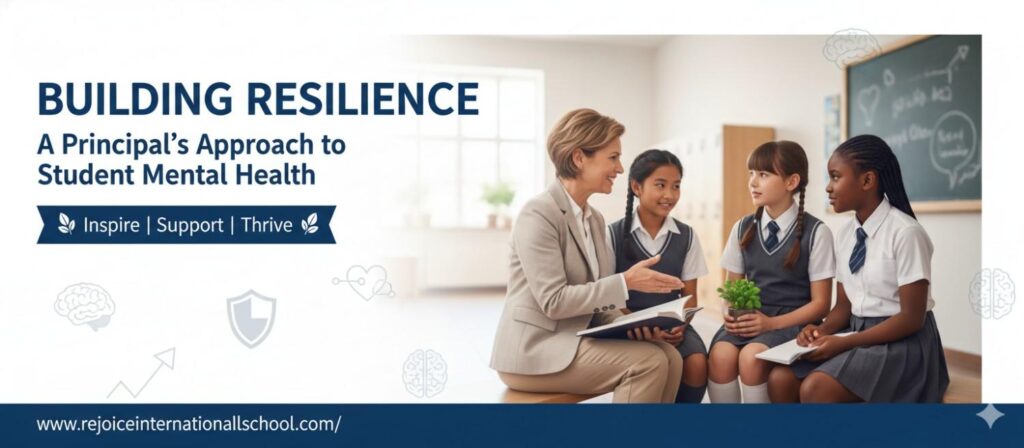
In today’s rapidly evolving educational landscape, student mental health has emerged as one of the most critical priorities for school leaders. While academic excellence remains important, it is no longer sufficient on its own. Students today navigate academic pressure, social expectations, digital overload, and uncertainty about the future.
As a school principal, I strongly believe that education must nurture not only intellectual ability but also emotional strength. At Rejoice International School, our philosophy of Happy Schooling places student well-being at the heart of learning, and building resilience is central to this vision.
Resilience is the capacity to adapt, cope, and grow in the face of challenges. It is not about eliminating stress or difficulty but about equipping students with the skills, mindset, and emotional support needed to face adversity with confidence. Guided by our mission of Explore, Experience, and Express (3E), we consciously work to develop resilient learners who are prepared for both academic demands and life beyond the classroom.
At Rejoice International School, we believe that education should go beyond textbooks. Whether parents are exploring ICSE schools an international primary school the focus should always include emotional development along with academic growth.
Creating an Emotionally Safe School Environment
The foundation of student mental health is emotional safety. Children thrive when they feel accepted, respected, and free from fear of judgement. As a principal, one of my foremost responsibilities is to create a school culture where mistakes are viewed as opportunities for growth rather than signs of failure.
At Rejoice International School, we promote respectful communication, inclusivity, and empathy. Students are encouraged to ask questions, take risks, and express themselves without fear. When children feel emotionally secure, they develop self-trust and the courage to persevere through challenges.
Practical Takeaway:
Establish a common, growth-oriented language across the school. Encourage teachers to replace punitive responses with reflective conversations that focus on learning and improvement.
Integrating Social and Emotional Learning
Resilience cannot be taught as a standalone lesson; it must be integrated into everyday school life. Social and Emotional Learning (SEL) plays a vital role in helping students understand and manage emotions, build empathy, and develop healthy relationships.
Through classroom interactions, assemblies, group discussions, and reflective practices, students learn to recognise their emotions, manage stress, and respond constructively to challenges. This aligns seamlessly with our 3E approach. When students explore their feelings, experience positive coping strategies, and express themselves openly, resilience becomes a lived experience rather than a theoretical concept.
Practical Takeaway:
Incorporate brief daily or weekly SEL practices such as emotion check-ins, gratitude reflections, or mindful breathing exercises to support emotional regulation. Teachers as Pillars of Support Teachers play a pivotal role in nurturing student mental health. Their daily interactions with learners place them in a unique position to notice changes in behaviour, mood, or engagement. As a school leader, I prioritise empowering teachers with the knowledge and confidence to respond to students with sensitivity and care.
Regular professional development sessions on child psychology, stress management, and trauma-informed teaching are essential. Equally important is supporting teacher well-being, as emotionally supported educators are better equipped to foster resilient classrooms.
Practical Takeaway:
Conduct regular training and create a supportive environment where teachers feel valued, heard, and encouraged to seek help when needed.
Empowering Student Voice and Agency
Resilience flourishes when students feel a sense of ownership and agency. At Rejoice International School, we actively create platforms that allow students to lead, make decisions, and take responsibility. Student councils, clubs, project-based learning, and peer mentoring opportunities enable learners to develop confidence, accountability, and problem-solving skills.
When students are trusted to contribute meaningfully, they learn to believe in their abilities and navigate challenges independently.
Practical Takeaway:
Encourage student-led initiatives where teachers act as facilitators, allowing students to plan, lead, and reflect on their experiences.
Strengthening School–Parent Partnerships
Student mental health is a shared responsibility between school and home. Strong partnerships with parents are essential in creating consistency and emotional security for children. At our school, we engage parents through workshops and conversations focused on emotional development, exam stress, digital well-being, and positive parenting practices.
When parents and educators work together, students receive a unified message of support, understanding, and encouragement.
Practical Takeaway:
Organise regular parent engagement sessions that address emotional well-being alongside academic progress.
Normalising Failure and Promoting a Growth Mindset
Fear of failure is one of the greatest barriers to resilience. As a principal, I consciously work to shift the focus from perfection to progress. We celebrate effort, perseverance, and improvement, helping students understand that setbacks are a natural part of learning.
By cultivating a growth mindset, students learn to approach challenges with curiosity and confidence rather than anxiety.
Practical Takeaway:
Highlight stories of resilience in assemblies and newsletters, recognising students for effort, kindness, and persistence—not only academic achievement.
Conclusion
Building resilience is not a program or a policy; it is a culture shaped by intentional, compassionate leadership. At Rejoice International School, we believe that true education goes beyond academic success—it nurtures emotional strength, self-belief, and emotional balance. Guided by our philosophy of Happy Schooling and our mission to Explore, Experience, and Express, we are committed to creating an environment where students feel safe, valued, and empowered to face life’s challenges with confidence.
By prioritising mental health, fostering a growth mindset, and strengthening partnerships between teachers, students, and parents, we aim to develop resilient learners who are not only academically capable but also emotionally grounded and socially responsible.
A resilient child grows into a confident, compassionate, and adaptable adult—and at Rejoice International School, nurturing such individuals is our enduring purpose.


